A foundational experience: challenges, learning and transformative encounters
After the PhD: academic vocation, but broader horizons
Some advice for daring mobility: rigor, funding… and openness
Finding one's course: research shaped by the French school of discourse
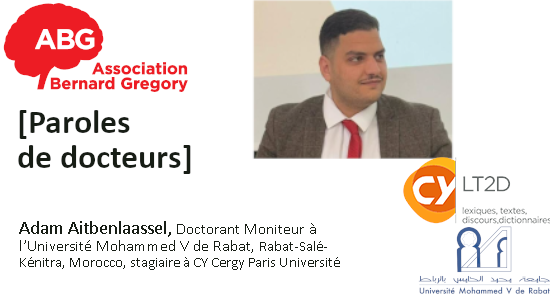
A PhD monitor at Mohammed V University of Rabat, Adam Aitbenlaassel dedicates his thesis to the analysis of discourse on international political crises. Early on, France emerged as a decisive step to structure his scientific approach. “French intellectual heritage has shaped my training since my bachelor's degree. When you work on discourse analysis, coming to France is not a neutral choice: it's returning to the sources,” he explains.
His subject crosses linguistics, information and communication sciences, political discourse analysis, rhetoric, and international communication. A coherence that naturally led him to the LT2D laboratory at CY Cergy Paris University: an immediate anchoring, he says, when he discovered the work of the "Media and Discourse Analysis" axis directed by Professor Luciana Radut-Gaghi.
With the support of the laboratory director, Christophe Rey, he obtained a letter of invitation, then a particularly selective doctoral mobility scholarship, resulting from Franco-Moroccan cooperation. “Being a laureate of this program twice was an immense encouragement. It gave me the strength to invest even more in my thesis.
A foundational experience: challenges, learning and transformative encounters
His scientific mobility opened with a reality well known to international doctoral students: finding accommodation in the Paris region. “Housing in Paris was the most difficult part. I lived in a temporary studio for a week before finding a stable solution thanks to friends,” he recounts. Administrative procedures, on the other hand, proceeded with surprising fluidity: the hosting agreement was obtained in less than a week thanks to the efficiency of the laboratory team.
On the scientific level, the impact was immediate. During his first stay, Adam wrote an entire chapter of his thesis devoted to institutional discourse during the Covid-19 crisis, mobilizing the concept of “discursive architecture” developed at LT2D. “This approach provided me with an analytical structure that I didn’t have before,” he emphasizes.
The laboratory, composed of researchers from many countries (Romania, Italy, Iran, Brazil, Egypt…), became for him a true space of openness. There he discovered scientific diplomacy in particular, a research field he didn’t know about and which reoriented part of his questioning toward geopolitical issues. The encounters he made there left a lasting mark: “Meeting Maingueneau, Charaudeau or Doury… these are moments that mark a career. You realize that research is a continuous dialogue, beyond borders.”
After the PhD: academic vocation, but broader horizons
Adam naturally projects himself toward higher education and research. “I want to become a professor-researcher. Transmission, mentoring, and scientific production are at the heart of my professional identity,” he affirms with conviction.
But his time in France also broadened his field of possibilities. He now understands that his skills in discourse analysis can find their place in European institutions, international organizations, NGOs, or think tanks. “Many are looking for profiles capable of decoding public discourse. I saw how discourse analysis can inform decisions on an international scale, and this opens unexpected perspectives.”
Some advice for daring mobility: rigor, funding… and openness
From his experience, Adam draws three lessons that, in his view, really make a difference when considering mobility in France.
1. Build a solid and sincere application
For Adam, everything starts with a clear, coherent, well-thought-out application. Not a “perfect” application, but one that shows the project is sound and the candidate knows where they’re going. He emphasizes the importance of taking care of the fundamentals—CV, publications, scientific coherence—but above all of assuming a form of intellectual honesty:
“What distinguishes a good application from an accepted application is the clarity of intention and the rigor of the project. You can immediately tell when a candidate knows why they’re going.”
2. Search actively—and intelligently—for funding
Adam reminds us that opportunities are numerous, but very few candidates take the time to explore them: Erasmus+, PHC Toubkal, AUF, CNRST–Campus France scholarships, Eiffel, internal university programs… For him, the key is simple: be vigilant, and don’t wait for information to fall from the sky.
“The difference between those who leave and those who give up is often a question of vigilance. The funding exists—but you have to go find it.”
3. Open yourself to others, to methods, to academic cultures
Finally, Adam insists on the attitude: remain curious, adapt, accept being challenged. Participate in seminars, ask questions, let yourself be surprised by new approaches…
“Mobility is not just a displacement: it’s an intellectual displacement. If you stay in your comfort zone, you miss 80% of what it can offer you.”
Finally...
Adam Aitbenlaassel’s trajectory shows what mobility can become when one fully commits to it: a scientific accelerator, an engine of personal transformation, and sometimes the beginning of an international career. For him, mobility is not simply a “plus” on a CV:
“It’s a foundational passage. An encounter between ideas, cultures, people—and a way to redefine what you want to become.”
An inspiring testimony, which reminds us that stepping out of one’s framework can open horizons one never suspected.
To go further…
Discover Adam AITBENLASSEL’s complete testimony, in extenso, with all the details of his journey, his in-depth advice, and his feedback: