Highlights of the European Doctoral Day 2026
On 13 May 2026, the first edition of the European Doctoral Day took place across Europe. As part of the EDD framework, ABG organised an online event that brought together doctoral candidates, postdoctoral researchers, career development professionals, employers and institutional representatives from across Europe and beyond. The event was organised together with its European partners: European University of Technology (EUT+), Euraxess France, the University of Strasbourg, the Polonium Foundation and the PAUSE Programme.
Dedicated to the theme "How a PhD Broadens Career Opportunities Outside Academia", this inaugural edition attracted more than 200 attendees joining the live webinar throughout the day.
In this article, you will find the programme highlights, key messages from the discussions, participants' feedback and resources to continue exploring doctoral career opportunities across Europe.
European Doctoral Day 2026 at a glance
Key takeaways for the future of doctoral careers in Europe
Feedback from the Participants
Resources for doctoral career development
European Doctoral Day 2026 at a glance
The European Doctoral Day (EDD) was created to foster dialogue between doctoral researchers, employers, higher education institutions and international organisations. At a time when career paths are becoming increasingly diverse and international, the event provided a space to discuss how doctoral training prepares researchers for a wide range of professional environments and societal challenges.
It is targeted at:
- doctoral candidates and PhD students from all disciplines;
- postdoctoral researchers considering career transitions;
- career development and international relations officers;
- recruiters and HR professionals from public and private sectors.
Key figures:
- Participants from Europe and beyond: France, Luxembourg, Ireland, Italy, the United Kingdom, Germany, Poland, Portugal, Spain, Belgium, Bulgaria, and Ukraine, but also Morocco, Cameroon, Algeria, and Mali, as well as Japan, India, Canada and Mexico.
- More than 200 live participants;
- 100% of respondents would recommend the event;
- 100% would participate in a future edition.
program details
The program of the European Doctoral Day comprised two thematic round tables, structured around European perspectives and concrete industry testimonies.
Opening – Welcome address
Jean-Luc Beylat, President of ABG
In his opening remarks, Jean-Luc Beylat, President of ABG, described the PhD not as a mere academic title but as a true "passport for innovation". He stressed the crucial role doctoral graduates can play in addressing Europe's major technological, economic and societal challenges. Yet while PhD holders are widely integrated into innovation ecosystems in the United States and several Asian economies, Europe still has progress to make in recognising doctoral competencies beyond academia — making stronger links between research, industry and society essential to its future competitiveness.
"Do not see the world outside academia as Plan B. It is a Plan A, where you can have a massive direct impact on the world and where you are the innovator who will help Europe address the challenges ahead." ( Jean-Luc Beylat)
Round Table 1 – European perspectives on doctoral careers
The first round table brought together representatives from major European organisations supporting doctoral careers and researcher development.
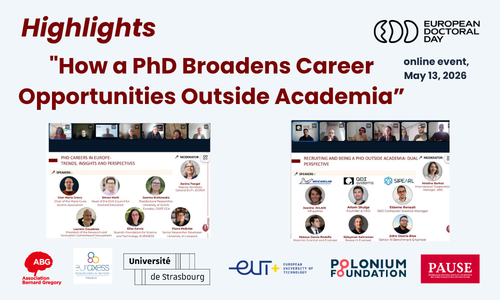
Speakers Laurent Gouzènes (MEDEF), Fiona McBride (Prosper), Gian Maria Greco (MCAA), Joanna Rutkowska (Eurodoc), Simon Marti (Head of the EUA Council for Doctoral Education), Elisa Garcia (Spanish Foundation for Science and Technology, EURAXESS), discussed recent European survey data, policy developments and emerging trends, examining how graduates navigate an increasingly diverse labour market and whether their competencies are recognised beyond academia.
The session was moderated by Janina Fengel, Deputy Secretary General of EUT+ and ECROS.
Key messages emerging from the discussion:
- Doctoral careers are becoming increasingly diverse. More than 50% of postdoctoral researchers in Europe are interested in career opportunities beyond academia, highlighting a growing demand for broader career pathways.
- Career development support remains uneven across Europe. Only 23% of postdoctoral researchers report receiving sufficient career guidance from their institutions, with lower levels of support in Southern and Eastern Europe.
- Doctoral talent contributes far beyond academia. These competencies position PhD holders as valuable professionals in industry, public administration, consulting, innovation, entrepreneurship and policy-making.
Round Table 2 – Recruiters and PhD professionals: a dual perspective
The second round table offered a unique format pairing recruiters and doctoral graduates currently working in innovative companies. Representatives from Michelin, (France) - Jeanine JOLAIN, HR partner, Mateus Garcia Rodolfo, Materials Scientist and Engineer, QDI Systems (The Netherlands) - Artem Shulga, Founder & CEO, Süleyman Kahraman, Research Engineer, and SiPearl (France, Spain, Italy) - Etienne Renault, R&D Computer Science Manager, John Osorio Ríos, Senior AI Benchmark Engineer shared their experiences of recruiting, integrating and working with PhD talent.
Key messages emerging from the discussion:
- Doctoral training can be a strategic pathway into industry. Programmes such as CIFRE allow researchers to combine academic excellence with industrial experience, facilitating professional integration and long-term career development.
- Successful integration goes beyond technical expertise. Onboarding, workplace culture, mentoring and regular communication play a crucial role in helping researchers transition from academia to industry.
- Industry highly values doctoral competencies. Employers seek professionals who can manage complexity, work across disciplines, understand cutting-edge technologies and bridge research with practical applications.
- Flexibility and adaptability are key assets. The ability to manage multiple projects, collaborate in diverse environments and embrace new challenges enables PhD holders to create impact across a wide range of sectors.
Key takeaways for the future of doctoral careers in Europe
In the closing remarks, Slaven Misljencevic (European Commission) reminded participants that while a PhD can broaden career opportunities, such transitions do not happen automatically: they depend on recognition, support, confidence, institutional practices and policy frameworks.
"The PhD can broaden career opportunities in many ways, but this does not happen automatically."
He stressed that the diversification of doctoral careers is not a passing trend but a structural shift: society increasingly needs researchers in companies, hospitals, public administrations, start-ups and international organisations, not only universities. Their competencies — critical thinking, decision-making, project management, problem-solving, adaptability — remain highly relevant yet often invisible, because researchers and employers do not always speak the same language. Career development support, he concluded, should be embedded in doctoral education from the start, with European initiatives such as EURAXESS and the European Competence Framework for Researchers playing a key role in supporting mobility and professional development.
Feedback from participants
The inaugural edition was warmly received by speakers and attendees alike, with discussions continuing beyond the webinar through professional networks. Combined with a 100% recommendation rate among survey respondents, this confirms the relevance of creating European spaces for dialogue on doctoral careers and researcher mobility.
Here is some of their feedback to the question "What did you like the most about the event?":
Several participants highlighted the European dimension of the discussions:
"I like the fact that it included different perspectives from different countries and stakeholders, which reveal a general trend in Europe. The round tables were rich in discussions and information."
The diversity and quality of the speakers were frequently mentioned:
"Excellent composition of speakers and their openness to share insights and experiences."
Participants particularly valued the dialogue between academia and industry:
"The idea exchange between academic and industry experts. Practical life examples of academic experts who have transitioned into the industry. The question and answer sessions."
Others underlined the practical value for career development:
"It was interesting to hear the recruiters' views and opinions about PhD holders. In addition, I learned that R&D is one of the fields where PhD holders can integrate most easily."
ABG warmly thanks all speakers, moderators, partners and participants for contributing to the success of this inaugural edition. The discussions initiated during this first European Doctoral Day will continue through future events, collaborations and resources dedicated to supporting doctoral talent across Europe.
Stay tuned for a forthcoming policy brief on doctoral career development, skills recognition and career pathways in Europe, as well as announcements regarding the next edition of the European Doctoral Day.
Resources for doctoral career development
Our Job board Our PhDs' testimonials ABG's country by country mobility guide
Find out more
REPLAY | ABG-RnMSH Webinar: “Careers Connecting Science and Society for PhDs in Humanities and Social Sciences” on June 11, 2026, 11:30 AM
Take part in a new edition of the Focus on Non-R&D Careers webinar series, organised by ABG in partnership with the National network of Centers for Social Science and Humanities (RnMSH).
This session will focus on discovering careers at the science–society interface that are accessible to PhD holders in Humanities and Social Sciences (HSS).
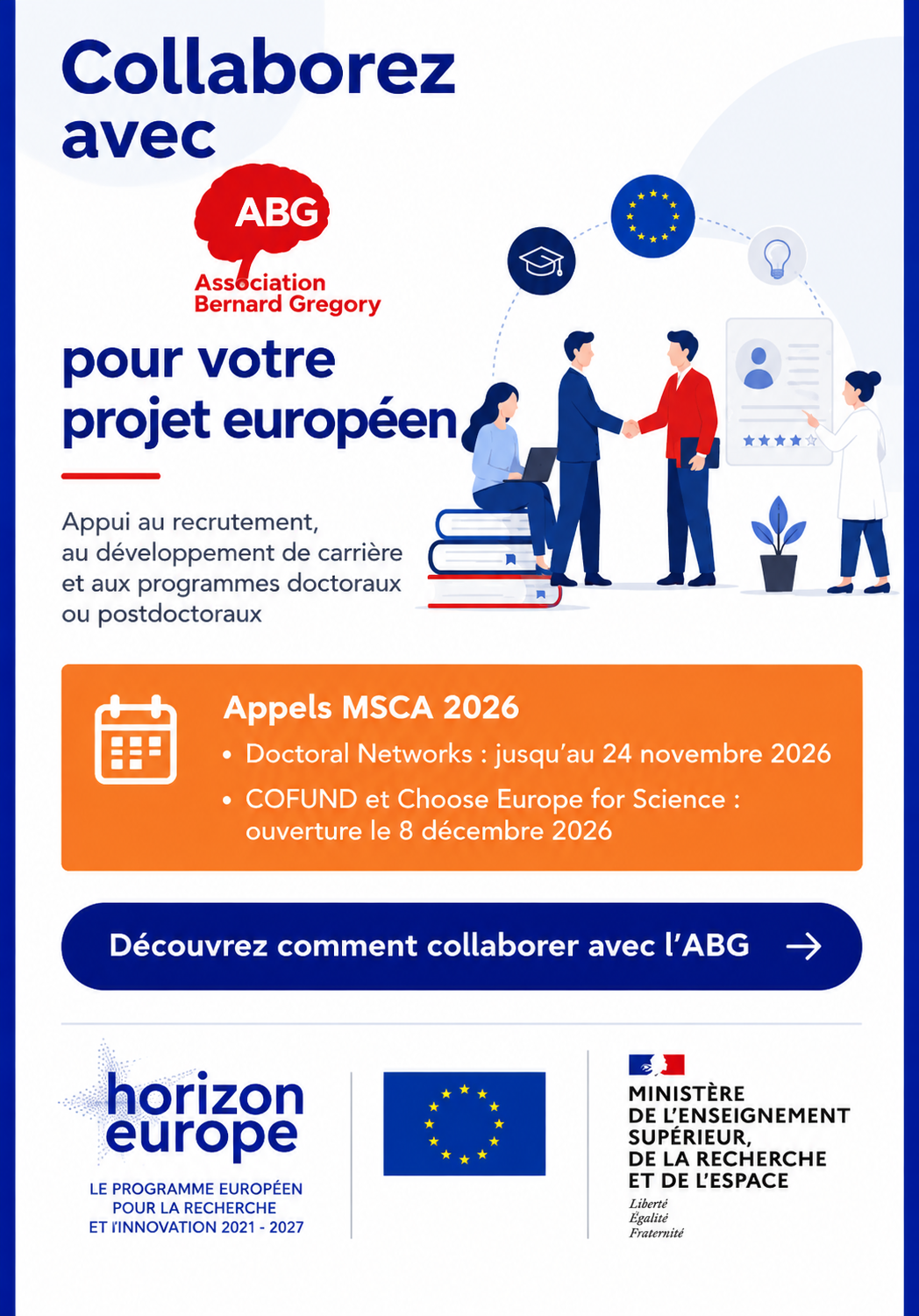
Collaborate with ABG for your European project
Are you preparing, coordinating or contributing to a European doctoral or postdoctoral project? ABG can join your project and bring its expertise in researcher training and career development, as a consortium partner, third party or subcontractor on a new or ongoing project.
Highlights of the French-Italian day for early career researchers 2023
On October 19th, 2023, the third edition of the French-Italian Day for early career researchers (from all disciplines) took place, marking the first edition on-site. The event was organized in Turin by the University of Turin and ABG, and with the support of the French Italian University. It provided a rare opportunity for students and researchers from both countries to meet and discuss with experts in the field of Franco-Italian mobility!
In this article, you can find the program, replay of all the sessions, and many resources designed to help you prepare your career evolution beyond academia.
Get ABG’s monthly newsletters including news, job offers, grants & fellowships and a selection of relevant events…
Discover our members
 Généthon
  Ifremer
  TotalEnergies
  SUEZ
SUEZ  Groupe AFNOR - Association française de normalisation
  Institut Sup'biotech de Paris
  Nokia Bell Labs France
  Medicen Paris Region
  ONERA - The French Aerospace Lab
  ASNR - Autorité de sûreté nucléaire et de radioprotection - Siège
  Tecknowmetrix
  ADEME
ADEME  Servier
  Laboratoire National de Métrologie et d'Essais - LNE
  Nantes Université
  ANRT
ANRT  Aérocentre, Pôle d'excellence régional